
Wednesday, March 16, 2011
Omc 115 Turbojet No Power
(73) CHANCE AD OF TSUNAMI IN THE COLOMBIAN CARIBBEAN / Rodrigo Restrepo G

"When you burn your neighbor's ranch, look within you" The popular refrainColombian
The swarm of earthquakes and tsunamis that occurred this week in Japan has attracted to know how far you can file a similar situation in our Colombian Caribbean.
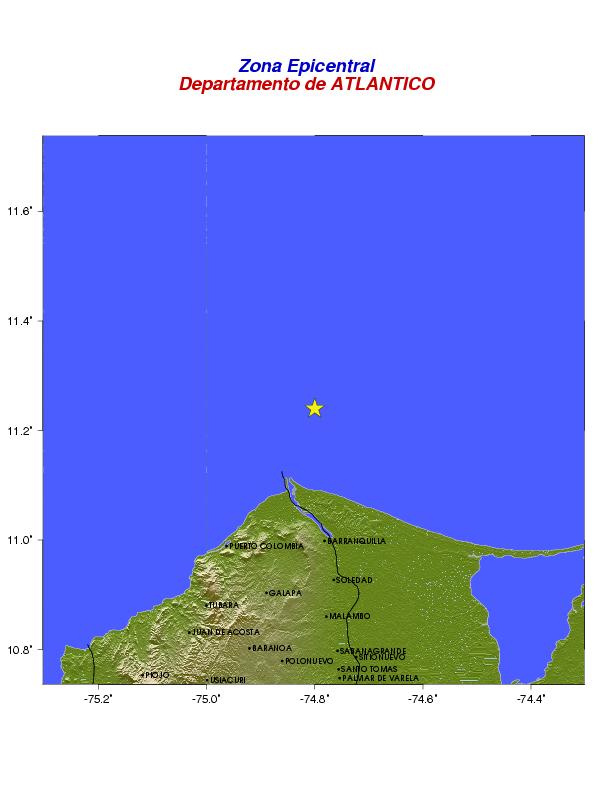
After the 4.4 magnitude earthquake with an epicenter just 26.6 miles northeast of Barranquilla, the May 2, 2006, I had the opportunity to share with Group Disaster Study Barranquilla - GDB , A presentation which was modeled the probability of a tsunami in our Caribbean coast, based on two scenarios likely and believable:
 The first reference to the tsunami nearest source occurred off Panama in 1886, which has a relatively favorable orientation toward our Caribbean. According to modeling done with simulators, the first wave of this event would reach the coast of Cartagena, where a tide gauge monitoring, in approximately 40 minutes and produce a wave of just over 20 centimeters.
The second draws on the earthquake of 1843 from distant source in the area of \u200b\u200bthe Lesser Antilles, near the island Antingua. Under this scenario, the gauge of Cartagena submit relevant records after 2 hours of occurrence of the earthquake, with waves increased by 40 centimeters on average.
However the results, which are due to simulations and likely sustained in the historical record, it should be noted that the climate change process has been showing extreme behaviors in the past three decades in relation to natural events potentially generate disasters, to the extent that it requires a process reengineering and standards review.
The context of recent events in Japan, which undoubtedly correspond to mixed events: earthquakes (still active at the time of this writing), tsunamis, man-made of a technological disaster (nuclear power generating plants ) and activation volcanic allow us to define this as a Disaster Complex, where probably the arrival of humanitarian aid and its sustainability will be very difficult and the recovery will take many years, effort, resources and international solidarity. This solidarity must become conscious of the need to improve risk management in our countries, for example, evaluating the benefit of power generation by nuclear plants, compared to the risk that they transform a simple disaster in a complex disaster .
Meanwhile, it is necessary and appropriate strengthening of the Territorial Plans Risk Management, as comprehensive as possible, involving of all involved including the organized community and the naming of the resources needed for implementation.
Recommended Reading:
- National Tsunami Detection and Alert - SNDAT in http://www.osso.org.co/ tsunami / , accessed 16/03/2011
- J. Caicedo, Martinelli B., Meyer H., Steer R.: "Impact of tsunami in the Caribbean Sea off the coast of Colombia, Southwestern Seismological Observatory, available in: http://www.osso.org.co/tsunami/modelamiento/caribe.zip , accessed 16/03/2011
- R. Restrepo, "Earthquake in Barranquilla, 2006, available at http://giramvndo.blogspot.com/2006/05/03tembl-en-barranquilla- rodrigo.html , accessed 03/16/2011
- R. Restrepo, "Reengineering in Emergency and Disaster Prevention", 2008, available at: http://giramvndo.blogspot.com/2008/ 07/35-reingenieria-en-la-prevencion-de.html , accessed 03/16/2011
- Interview with Bernardo Aliaga, a specialist in tsunamis of the Intergovernmental Oceanographic Commission of UNESCO, which This explains What to do if a tsunami warning issued on March 18, 2011 at the UN Web Radio . Production: Laura Kwiatkowski. Next:

Other trials, reviews and discussions Giramundo: http://giramvndo.blogspot.com/ 

Subscribe to:
Post Comments (Atom)
0 comments:
Post a Comment